
Table of Contents
SUNLU offers high-quality TPU (Thermoplastic Polyurethane) filaments in both 90A and 95A Shore hardness variants, catering to different needs in flexible 3D printing. The key difference lies in the Shore A hardness scale, where higher numbers indicate a firmer material. 90A is softer and more elastic, while 95A is stiffer and more rigid—both remain highly flexible compared to rigid filaments like PLA.
Understanding Shore Hardness
Shore A measures resistance to indentation for flexible materials:
- Lower values (e.g., 90A) → softer, more stretchable.
- Higher values (e.g., 95A) → firmer, better at holding shape.


For context, 95A feels like a hard rubber (e.g., shopping cart wheel), while 90A is slightly softer and more compressible.
Key Differences: 90A vs 95A
| Aspect | TPU 90A | TPU 95A |
|---|---|---|
| Hardness | Shore 90A (softer) | Shore 95A (firmer) |
| Flexibility/Elasticity | Higher elasticity, more stretchable and compressible. Ideal for repeated bending. | Good flexibility but less stretch; better shape retention under load. |
| Durability/Wear Resistance | Excellent abrasion and impact resistance; superior aging resistance. | Excellent, with slightly higher surface hardness for friction-heavy uses. |
| Printability | More challenging: requires slower speeds to avoid buckling/stringing. | Easier, especially on Bowden printers; supports higher speeds and better dimensional stability. |
| Printing Settings (SUNLU Recommendations) | Nozzle: 220-240°C Speed: ≤40mm/s Bed: 50-60°C | Nozzle: 190-230°C (lower range allows 50-120mm/s) Bed: 50-60°C |
| Common Features | Both: 1.75mm diameter (±0.03mm tolerance), bubble-free, vacuum-sealed, antibacterial/mildew-resistant (especially highlighted for 90A), oil-resistant. | Same as 90A. |

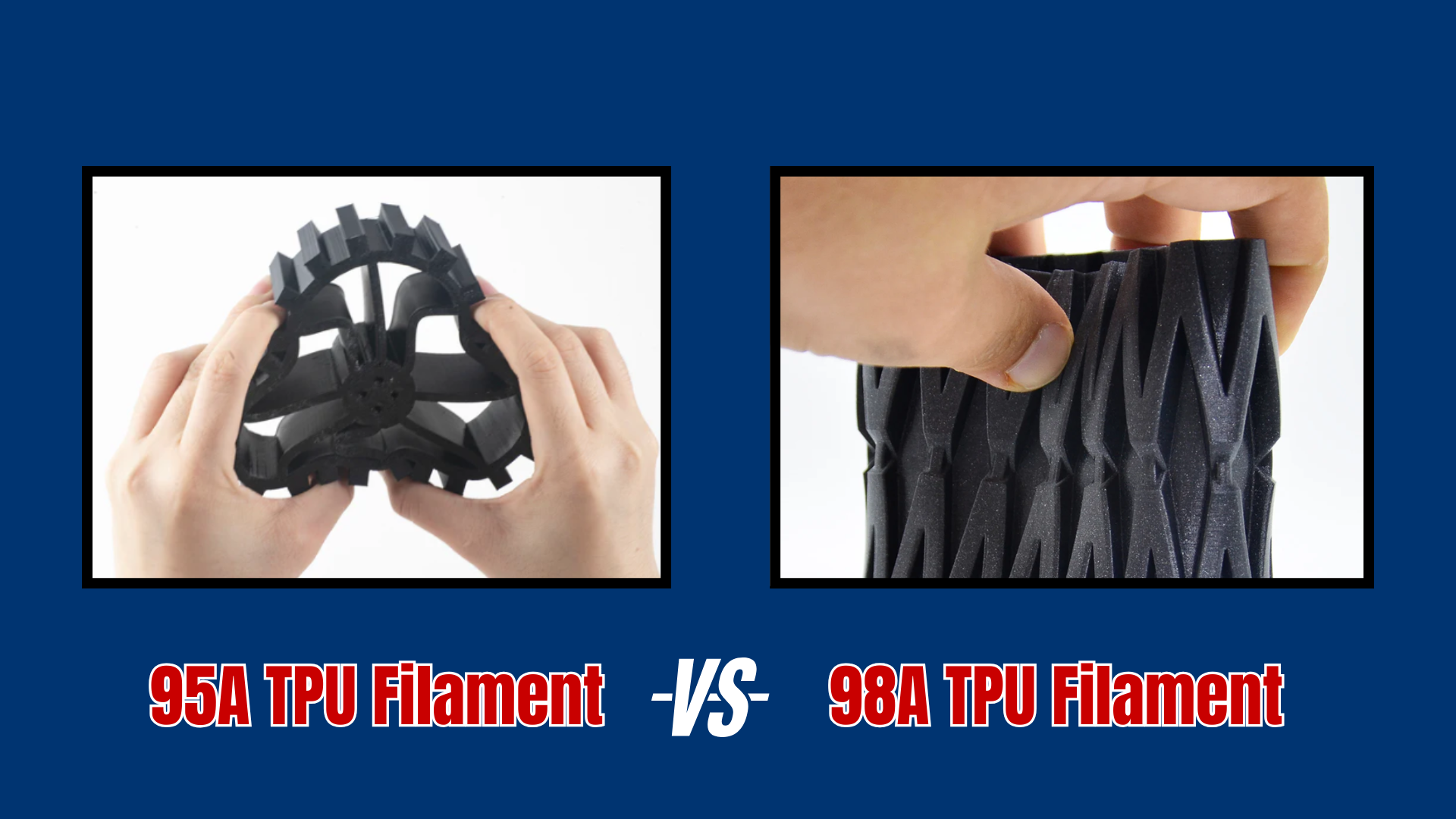
These visuals show bend tests and comparisons—notice how softer TPUs (like 90A equivalents) deform more easily.
Best Applications
-
Choose 90A for maximum flexibility:
- Phone cases, watch bands, shoe insoles/soles.
- Seals, gaskets, plugs needing high compression.
- Wearables or parts with extreme bending/shock absorption.
-
Choose 95A for balanced flexibility with structure:
- Tool handles, protective covers, drone parts.
- Tires, rollers, or items exposed to friction.
- Sports gear or daily-use items needing impact resistance without excessive softness.
Both excel in everyday scenarios like custom protective gear or functional prototypes.
SUNLU Spools
SUNLU TPU spools look similar across variants, with clear labeling for hardness.


Final Thoughts
If you prioritize ultra-soft, highly elastic prints and don't mind slower printing, go for SUNLU TPU 90A. For easier printing, better precision, and parts that hold shape, 95A is the versatile choice—it's the most common TPU hardness for good reason. Both deliver SUNLU's signature quality: excellent layer adhesion, no bubbling, and long-lasting performance.
Test a small print to feel the difference— the 5-point hardness gap makes a noticeable impact!

