
Table of Contents
If you're tired of stringing, weak layers, and failed prints from moist Nylon, PC, or CF filaments, a dedicated filament dryer is essential. But not just any dryer—the SUNLU E2 FilaDryer stands out as a premium 2-in-1 solution that dries and anneals up to 110°C+.
In this SUNLU E2 filament dryer review, we'll break down its specs, real-world performance, pros/cons from verified users, and whether it's worth the ~$350 investment in 2026. Whether you're a hobbyist upgrading from a SUNLU S2/S4 or a pro battling hygroscopic engineering materials, this guide has you covered.


What Is the SUNLU E2 Filament Dryer?
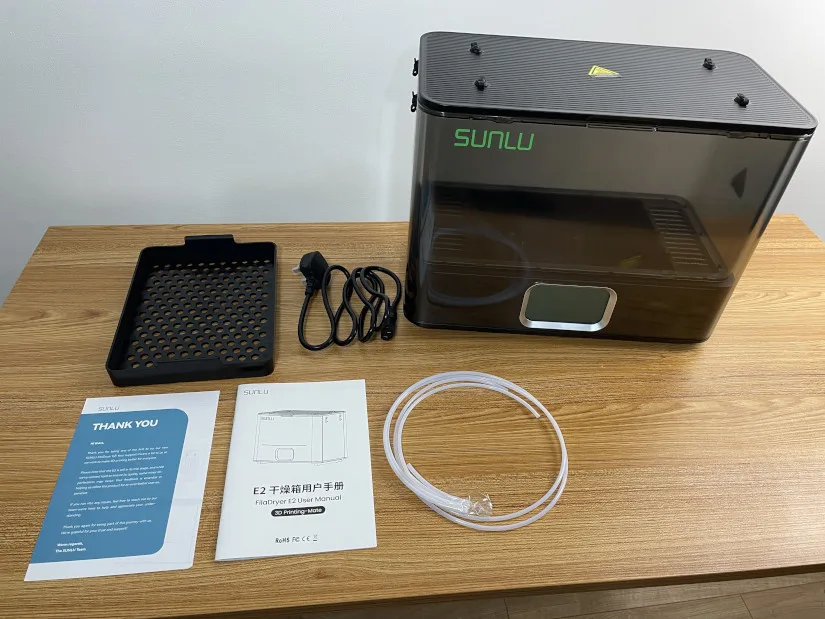
The SUNLU FilaDryer E2 is a large-capacity, high-temperature filament dryer designed specifically for advanced 3D printing. Unlike basic dryers limited to 50–70°C, the E2 reaches 35–110°C with a powerful 500W PTC heater—perfect for drying moisture-sensitive filaments like PA6-CF, PA12-CF, PC, ABS, ASA, and even annealing printed parts for better strength and dimensional stability.
Key Specs (sourced from official SUNLU site):
| Feature | Details |
|---|---|
| Max Temperature | 110°C (reaches ~112°C in tests) |
| Capacity | 2× 1kg, 2× 2kg, or 1× 3kg spools |
| Interior Dimensions | 372 × 192 × 255 mm |
| Heating Power | 500W PTC + barrel fan |
| Timer | 0–99 hours |
| Humidity Display | 10–90% (±10% accuracy; protects >80°C) |
| Weight / Size | 6.1 kg net / 400 × 220 × 307 mm |
| Extras | Dual-chamber insulation, magnetic seal, PTFE tubes, annealing tray |
It includes intelligent safety (over-temp alarms, auto shutoff, external surface stays <60°C) and works with 1.75mm, 2.85mm, or 3.0mm filament.

Key Features That Make the E2 Stand Out
- True High-Temp Drying & Annealing — Dries Nylon/PC in hours and anneals parts (80–90°C for 2–3 hours) to boost impact resistance—no separate oven needed.
- Spacious Dual-Chamber Design — Excellent airtightness and insulation for multi-spool use or large 3kg rolls.
- User-Friendly Touchscreen — Real-time PV/SV temp, humidity, timer, and preset filament modes.
- Safety First — Fireproof materials, dual-level protection, and quiet(ish) operation for workshop use.
Pros and Cons of the SUNLU E2
Pros (from aggregated reviews):
- Transforms print quality for engineering filaments (no more popping or delamination).
- Excellent annealing for functional parts (gears, drone components, helmets).
- Fast heat-up (~20–32 min to 50–110°C) and stable temps.
- Premium build with strong seals and low external heat.
- Versatile for 1–3kg spools.
Cons:
- Pricey (~$350; overkill for PLA-only users).
- Noisy fan (common complaint).
- Basic/slow UI and occasional minor uneven heating.
- Early units had temp overshoots (mostly fixed via firmware).
- Bulky footprint.
Real User Reviews: What Owners Actually Say
Real feedback is overwhelmingly positive for targeted use:
- Amazon buyer RandomGeek (5/5, Jan 2025): "Night and day difference with old nylon... annealing strengthened my prototype gear."
- Reddit presale user: "Game-changer for PA/PC prototypes."
- Prusa Forum: "Performs as advertised... really satisfied."
- 3DHeaven.de: "Outperforms Bambu AMS HT on temp... best for pro engineering users."
- Macy Makes YouTube: "Premium feel... flawless TPU/PETG/nylon prints."
Some note the cost or noise, and one Reddit user reported uneven temps on an early unit (firmware reportedly improved this). Overall rating across sources: ~4.5/5 for serious makers.
Is the SUNLU E2 Worth It in 2026?
Yes—if you print engineering filaments regularly. The annealing function alone saves time and money versus a separate oven. At $349–$360 (often on sale ~$240–$300 presale/Amazon), it's a solid investment for pros or serious hobbyists. Casual PLA users should stick with cheaper options like the SUNLU S2/S4 (~$100–$150).
Who Should Buy It?
- Users of Nylon, PC, CF blends, or ASA.
- Makers who anneal parts for strength.
- Those wanting one device for drying + post-processing.
Who Should Skip It?
- Budget beginners or PLA/PETG-only printers.
SUNLU E2 vs. Alternatives
- SUNLU S4/SP2: Cheaper, multi-spool, but max ~65–70°C—no annealing or high-temp engineering support.
- Bambu AMS HT: Integrated but lower max temp (~102°C) and less flexible.
- Cheap lab ovens: Similar temps for less, but no filament-specific seals or easy spool feeding.
- Eibos or PrintDry: Good but rarely hit 100°C+ reliably.
The E2 wins for versatility and pro features.
Final Verdict & Recommendation
The SUNLU E2 filament dryer delivers where it matters most: reliable high-temp drying and annealing that unlocks the full potential of engineering filaments. With strong real-user results, robust safety, and spacious design, it's one of the best high-temp filament dryers available in 2026 for dedicated makers.
If your prints demand strength and consistency, grab one—you won't regret it. Check current pricing on SUNLU official store or Amazon (search "SUNLU E2 filament dryer").
Have you tried the E2? Drop your experience in the comments!
FAQs Does the SUNLU E2 reach 110°C? Yes—tests show ~112°C, ideal for Nylon/PC. Can it anneal printed parts? Absolutely—built-in mode strengthens ABS, PA, etc. Is it noisy? Moderately (fan-driven), but expected at this power level. Warranty/Support? Standard SUNLU 1-year; responsive per reviews.

